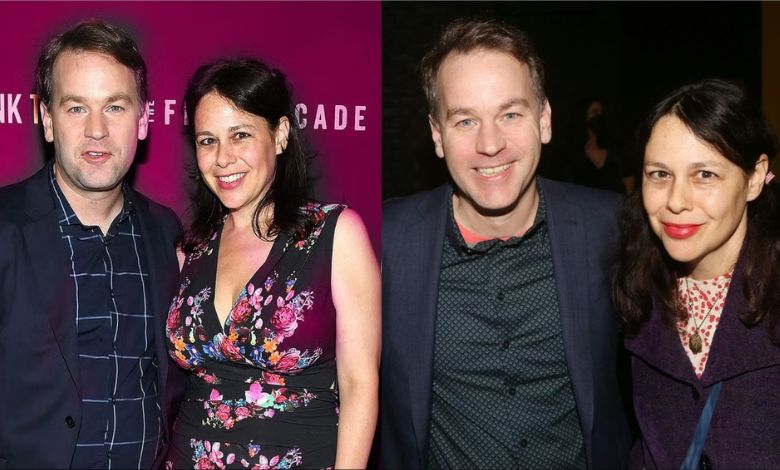
J. Hope Stein is an American poet and author whose public work is closely tied to contemporary poetry, motherhood, marriage, and creative collaboration. She is also widely recognized as the wife of comedian, actor, writer, and storyteller Mike Birbiglia. While her name often appears in connection with Birbiglia’s stage and book projects, Stein has a distinct literary identity built through poetry collections, chapbooks, published poems, and public literary appearances.
Her best-known works include little astronaut, published by Andrews McMeel in 2022, and Occasionally, I remove your brain through your nose, published by Poet Republik in 2017. She also collaborated with Mike Birbiglia on The New One, a 2020 book published by Grand Central that combines prose and poetry. The Academy of American Poets identifies Stein as the author of those poetry works and notes her collaboration on The New One.
A factual biography of J. Hope Stein should begin with a clear distinction: she is not only “Mike Birbiglia’s wife.” That phrase explains why some readers discover her, but it does not fully describe her career. Stein’s public profile rests on her own writing, especially poetry that explores domestic life, early parenthood, emotional change, and the strangeness of ordinary experience.
Profile Summary
| Field | Details |
|---|---|
| Full name | Jennifer Hope Stein / J. Hope Stein |
| Professional name | J. Hope Stein |
| Known for | Poet, author, collaborator on The New One, Mike Birbiglia’s wife |
| Main profession | Poet and writer |
| Notable books | little astronaut; Occasionally, I remove your brain through your nose |
| Collaborative work | The New One with Mike Birbiglia |
| Spouse | Mike Birbiglia |
| Child | Public interviews mention their daughter, Oona |
| Public data limits | Birth date, early education, and extended family details are not widely confirmed in major public sources |
Early Life and Public Background
Public information about J. Hope Stein’s early life is limited. Major literary profiles focus more on her published work than on personal biography. Details such as her birth date, family background, education history, and early private life are not consistently documented in widely available authoritative sources.
This absence of public data should not be treated as a gap to fill with assumptions. Many writers, especially poets, maintain a selective public presence. Stein’s public identity is primarily professional and literary, not celebrity-driven. Her available biography is strongest when it focuses on her books, poems, collaborations, readings, and interviews.
The name “Jennifer Hope Stein” appears in some public event descriptions and interviews, while “J. Hope Stein” is the professional name most often used for her poetry and books. For SEO and clarity, both names may be mentioned, but the article should mainly use the name under which she publishes.
Poetry Career and Literary Work
J. Hope Stein’s work has developed across chapbooks, full-length poetry collections, collaborative writing, and literary platforms. The Poetry Society of America identifies her as the author of chapbooks including Talking Doll, Mary, and Corner Office. It also notes that her poems have appeared or were forthcoming in publications such as Verse, HTML Giant, Tarpaulin Sky, Everyday Genius, Ping Pong, Talisman, and Poetry International.
Her poetry often turns private emotional experience into concise and observant language. Rather than presenting domestic life as simple or sentimental, her work examines its contradictions. Her writing can be intimate, humorous, restrained, and sharp. This is especially visible in poems connected to motherhood and marriage, where the personal becomes a way to explore identity, exhaustion, tenderness, and change.
Stein’s literary profile expanded through little astronaut, a collection that brought her motherhood poems to a wider audience. Simon & Schuster describes the book as a poetry collection about the beautiful and disorienting period of new motherhood, presenting the experience as both otherworldly and deeply human.
Also Read: Alfie Karmal: What Is Known About Heather Mills’ Former Husband
Books by J. Hope Stein
J. Hope Stein’s major published books include Occasionally, I remove your brain through your nose and little astronaut. The Academy of American Poets lists Occasionally, I remove your brain through your nose as a 2017 Poet Republik publication and little astronaut as a 2022 Andrews McMeel publication.
little astronaut is especially important in understanding her wider public recognition. The collection focuses on new motherhood, but it does not reduce motherhood to a single emotion. Instead, the book examines the shifting mental and emotional landscape of becoming a parent. It treats motherhood as a major life change, not simply as a sweet domestic subject.
Her earlier chapbooks also matter because they show that Stein had an established poetry presence before her more visible collaborations with Birbiglia. For readers interested in her literary development, these chapbooks help place little astronaut within a broader body of work.
Marriage to Mike Birbiglia
J. Hope Stein is married to Mike Birbiglia, a comedian and storyteller known for stage shows, films, books, podcasts, and Netflix specials. Their marriage is part of Stein’s public profile because their creative lives have intersected in visible ways.
The most prominent example is The New One. Publishers Weekly described the book as a project in which Birbiglia explores his mixed feelings about becoming a parent, while Stein’s lyrical interludes appear alongside his prose passages.
This collaboration placed both writers’ voices in conversation. Birbiglia’s work often uses long-form storytelling and comedy to examine vulnerability, family, fear, and personal change. Stein’s contribution adds a poetic counterpoint. Her writing brings compression, emotional texture, and a different rhythm to the shared subject of parenthood.
Public interviews also mention the couple’s daughter, Oona. McSweeney’s introduced one interview by noting that in 2016, Birbiglia and Stein took their 14-month-old daughter, Oona, to the Nantucket Film Festival. That detail is publicly documented, but responsible coverage should avoid expanding into private family information beyond what credible sources provide.
The New One and Creative Collaboration
The New One is one of the clearest examples of Stein’s role as both a poet and collaborator. The project exists across stage, book, and performance culture. The book version is especially relevant because it directly credits both Birbiglia and Stein.
The Academy of American Poets describes The New One as a book of prose and poetry created with Mike Birbiglia. This format matters because it prevents the work from being framed as only a comedian’s parenting memoir. Stein’s poems are part of the structure and emotional meaning of the book.
The collaboration also reflects a broader theme in Stein’s writing: the tension between private experience and public storytelling. Parenting and marriage are personal subjects, but in The New One, they become literary material. Stein’s contribution helps ground the project in emotional observation rather than performance alone.
Also Read: Sunshine Deia Tutt: What Is Known About Chris Kattan’s Ex-Wife
Motherhood as a Central Theme
Motherhood is one of the most visible themes in J. Hope Stein’s public work, especially through little astronaut and The New One. Her writing does not present motherhood as a flat identity. Instead, it shows motherhood as an experience that changes time, language, attention, and the body.
In interviews about little astronaut, Stein has discussed the collection’s varied forms and modes, including lullaby, love song, commentary, short poems, longer poems, and call-and-response structures. The Rumpus interview highlights the formal range of the book and shows how Stein approaches motherhood as both subject and structure.
This makes her work valuable beyond biographical curiosity. Readers interested in contemporary poetry, women’s writing, parenting literature, and hybrid literary forms can find a clear point of entry through her motherhood poems.
Philanthropy / Public Engagement
There is no widely documented public record showing J. Hope Stein as a major philanthropist or charity campaigner. A factual biography should not attach philanthropic work to her unless supported by reliable sources.
However, Stein has taken part in documented public literary engagement. She has appeared in interviews, author conversations, and book-related events. For example, Skylight Books hosted a “Jokes and Poems” event with J. Hope Stein and Mike Birbiglia in connection with Stein’s poetry collection little astronaut.
Her public engagement is therefore best described as literary rather than philanthropic. She participates in the public life of poetry through books, readings, interviews, collaborations, and literary conversations.
Public Perception and Misconceptions
One common misconception is that J. Hope Stein is known only because she is Mike Birbiglia’s wife. That description is incomplete. Her marriage to Birbiglia is part of her public context, but her poetry career is independently documented through books, chapbooks, poems, and literary platforms.
Another misconception is that The New One is only Birbiglia’s work. The published book is credited as a collaboration, and Stein’s poems are part of its design. Treating it as a single-author project overlooks her contribution.
A third misconception is that Stein’s work is only about motherhood. Motherhood is a major theme, especially in little astronaut, but her wider writing record includes chapbooks and poems outside that single frame. The better reading is that motherhood became one of her most public subjects, not her only subject.
Legacy and Future
J. Hope Stein’s current literary legacy rests on her ability to bring poetic attention to ordinary life, especially the emotional complexity of parenthood and marriage. Her work has value because it treats domestic experience as serious literary material without making it overly dramatic.
It is too early to make broad claims about her long-term place in American poetry. Still, her published books, chapbooks, and collaboration on The New One give her a clear position in contemporary literary culture. Any discussion of her future should remain measured. If she publishes more books, appears in new literary projects, or joins additional collaborations, her public profile may continue to develop through the same careful, work-centered path.
Also Read: Who Is Lainya Shearer? Facts About Alan Shearer’s Wife and Family Life
FAQ’s
Who is J. Hope Stein?
J. Hope Stein is a poet and author known for little astronaut, Occasionally, I remove your brain through your nose, and her collaboration with Mike Birbiglia.
Is J. Hope Stein Mike Birbiglia’s wife?
Yes, she is publicly identified as Mike Birbiglia’s wife and creative collaborator.
What books has J. Hope Stein written?
Her known books include little astronaut and Occasionally, I remove your brain through your nose.
Did J. Hope Stein work on The New One?
Yes, she collaborated with Mike Birbiglia on The New One, a book combining prose and poetry.
Is there much public information about J. Hope Stein’s early life?
No, details such as her birth date, early education, and extended family background are limited in major public sources.
Conclusion
J. Hope Stein is a poet and author known for little astronaut, Occasionally, I remove your brain through your nose, and her collaboration with Mike Birbiglia on The New One. She is also publicly known as Birbiglia’s wife, but her identity should not be reduced to that relationship.
The strongest verified information about Stein concerns her writing career, published books, public literary appearances, and collaborative work. Details about her early life, education, and extended private background remain limited in major public sources. A credible biography should acknowledge those limits rather than guessing.
Her work stands out for its clear attention to motherhood, marriage, emotional change, and the private moments that shape public storytelling. J. Hope Stein’s biography is best understood through her writing: precise, personal, and grounded in the complexity of real life.